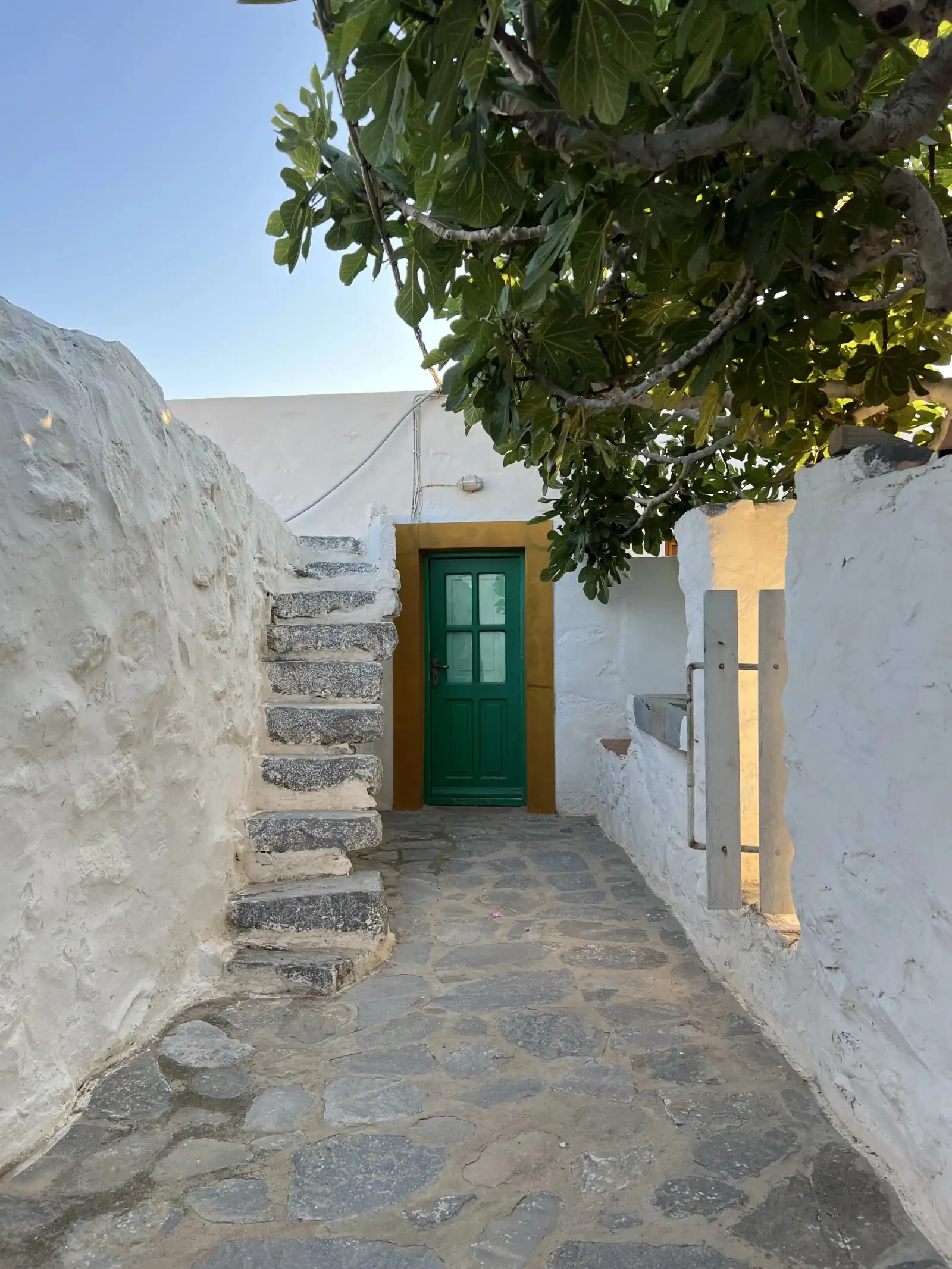
We spent more time in Greece than anywhere else in our four years on the water. Three sailing seasons, dozens of islands, and a stretch on the mainland that ended up being the longest we stayed anywhere.
Greece is the one people daydream about. Blue water, white houses, cheap food, kind people. Most of that is true. But a holiday in Greece and a life there with children are two different things, and the difference is mostly bureaucracy, not many school options, and winters nobody takes pictures of.
So this is the honest version.
Cost of living: cheap, once you're outside Athens
Greece is one of the most affordable countries in Western Europe, especially once you get out of Athens.
Here are the two Greek locations in our cost-of-living calculator. They're our own estimates for a family of four, in US dollars per month, put together from Numbeo, Expatistan, the International Schools Database and expat forums. They're there for comparing places, not for precision.
| Location | Rent (3-bed) | Groceries | Healthcare | Int'l school (1 child) | Total incl. school & childcare | Total excl. school & childcare |
|---|---|---|---|---|---|---|
| Athens | $1,000 | $500 | $150 | $1,000 | $3,800 | $2,300 |
| Crete | $800 | $450 | $140 | $800 | $3,190 | $1,990 |
On the same basis, the calculator puts Lisbon at $4,680 and Valencia at $4,100 a month. Greece is the cheapest of the three, particularly if you don't need an international school. Try your own numbers in the calculator.
The table can't show how much costs change from one part of the country to another:
- Athens has got more expensive, especially rents in sought-after neighbourhoods like Kifisia and Glyfada.
- Thessaloniki is cheaper, has great food and feels like a proper city.
- On islands like Paxos, Ios and Corfu, rents drop off-season but so does the choice, and summer prices can make your eyes water.
- Smaller mainland towns are very affordable but have little in the way of an international community. We didn't spend much time inland :).
Groceries are cheap, particularly at the laiki agora (street markets). Eating at a local taverna costs surprisingly little, and fresh fish at the port is often cheaper than at the supermarket.
Visas and residency
This is a high-level overview, not legal advice. Greek rules have changed several times in the last few years and are still changing. Check the official website of the Greek consulate that covers where you live, and think about talking to a qualified immigration lawyer before you apply. Our family visa guide covers how to think about the decision.
EU citizens
You don't need a visa. If you stay longer than three months you have to register your residence, the same as anywhere in the EU.
Digital Nomad Visa
This is for people working remotely for employers or clients outside Greece. The baseline is €3,500 a month in net income, plus 20% for a spouse and 15% for each child. For a family of four that comes to €5,250 a month. The visa lasts up to 12 months, and after that you can apply for a two-year residence permit, which is renewable. Holders and their families can't take a job with a Greek employer or run a business in Greece. According to Global Citizen Solutions, since February 2026 you have to apply through a Greek consulate before you travel rather than from inside Greece, so plan around that.
Financially Independent Person permit
This is the passive-income route for people who won't be working. The threshold is set separately, so check the current figure with the consulate.
Golden Visa
The property investment route still exists, but the thresholds have gone up a lot. Since September 2024 the minimum is €800,000 in Attica, Thessaloniki, Mykonos, Santorini and islands with more than 3,100 inhabitants, and €400,000 everywhere else. A €250,000 tier is left only for commercial buildings converted to residential use or restorations of listed buildings.
Whichever route you take, it's slow. Greek bureaucracy has a reputation, and it's earned. Appointments get cancelled, offices keep short hours, and you'll be asked for documents nobody mentioned before. Allow twice as long as you'd expect for anything administrative. We've heard of families waiting many months for a simple residence registration and others getting it done fast. Mostly it comes down to luck and which regional office you end up with.
Schools
At the young end, compulsory education in Greece starts earlier than people expect. It runs from age 4 to 15: two compulsory years of pre-primary (nipiagogeio), six years of primary and three years of lower secondary.
Greek public schools
Lessons are in Greek, and in most cases there's not much formal language support for children arriving from abroad. The idea is that your child learns Greek by immersion. That works, but there's usually a long, hard stretch first, especially for older kids. Quality varies enormously. Urban schools in Athens and Thessaloniki tend to have more resources. Island schools can be small and underfunded, though being part of a tight community has its own upside.
International schools
Most are in Athens and Thessaloniki, with a handful elsewhere. They follow IB, British or American curricula, and some follow the French or German systems. In Athens, the International Schools Database lists 23 international schools, with published 2026/27 fees from roughly €6,120 to €17,320 a year:
- Deutsche Schule Athen: €6,120
- Byron College: €8,580 to €14,300
- ACS Athens: €9,050 to €16,348
- St. Catherine's British School: €9,950 to €17,320
About half the schools don't publish fees, so you'll have to ask. Outside the two big cities, the choice falls away quickly.
Homeschooling
A lot of people get this wrong. Greek law requires children to attend school, and home education is only allowed in specific cases, such as children with serious health problems or special educational needs, and only with authorisation from the education directorate. It isn't a recognised alternative to school for families who'd just prefer it. Some international families do teach their kids at home or use online schools, but if you plan to live in Greece long term with school-age children, get proper local advice before you commit. Our post on school when there is no school covers how families handle gaps in schooling, but it doesn't change the legal position here.
Healthcare
The Greek public system (ESY) deals with emergencies well, but whether foreign residents can use it depends on their status. Access usually depends on social insurance and an AMKA (social security number). If you're in Greece on a Digital Nomad Visa, a Financially Independent Person permit or a Golden Visa, you usually won't qualify for public cover, so you'll need private insurance. The visa requires it anyway.
Most international families go private. Private clinics in the cities are clean and modern, and the doctors often speak English. Premiums depend a lot on age and how much cover you want. One insurance guide quotes roughly €50 to €100 a month for basic plans and €250 to €500 or more for comprehensive international plans. Read the small print. The cheapest plans that technically meet the visa rules can have high deductibles and small networks.
On the islands, medical care is more limited, and a small island may only have a basic health centre. For anything serious you'll be taking a ferry or a flight to a bigger island or the mainland. Think about that if someone in the family has an ongoing health condition. Our healthcare guide for families moving abroad has more on choosing cover, including what we learned about medical care on the islands the hard way.
Pharmacies are excellent. Greek pharmacists are well trained and can help with all sorts of minor problems.
Best places for families
Athens and its suburbs
The most international schools, the best hospitals and an airport that connects to everywhere. The northern suburbs like Kifisia and the southern coastal suburbs like Glyfada are popular with international families.
Thessaloniki
A big, lively city that costs less than Athens, with good food and a smaller international school scene. Winters are colder than in Athens.
Crete
Big enough to have real towns, hospitals and life all year round, and the season runs much longer than on the smaller islands. It's a good middle ground if you want island life without everything shutting for winter.
Corfu and the Ionian
Green, beautiful and close to Italy. There are established groups of international families, but it's quieter in winter.
Small islands
We loved them, and you won't forget them. They're best for a season or a year with younger children, or for families who are fully signed up to island life, winter included.
Community
The international family community in Greece is smaller and more scattered than in Portugal or Spain. Athens has a solid one. Crete and Corfu have small, settled groups of international families. On a smaller island you might be the only one.
Greeks are warm and generous, and family comes first. If you have kids, people open up faster. Our children were constantly being fed, hugged and fussed over by strangers in a way you wouldn't see in northern Europe. That warmth is real, and it makes day-to-day life feel friendly.
Close friendships take longer, and they take Greek. People socialise with family first, then close friends, then everyone else. Getting into that inner circle takes the language, patience and turning up again and again.
The downsides
Winter. Nobody posts photos of Greece in February. The islands go quiet to the point of feeling empty, and a lot of restaurants and shops close until spring. On a small island, winter can be really isolating. Northern Greece gets properly cold, with snow in the mountains.
Bureaucracy. We've covered it, but it's worth saying twice. Nothing happens quickly. Documents go missing. Offices close without warning. You'll find reserves of patience you didn't know you had.
On smaller islands the internet can be patchy, power cuts happen, and the roads are hit and miss. If you work remotely, check the connection before you commit to a place.
And if your kids need to be taught in English, your choice of location shrinks a lot, and homeschooling isn't the easy fallback it is in some other countries.
Your first month in order
Our first 90 days checklist has the full version. In Greece, the first month usually looks like this:
- Get your Greek tax number (AFM). You'll be asked for it all the time.
- Sign a proper lease so you have proof of address.
- Start your residence permit process (or EU registration) straight away. Expect several visits.
- Open a bank account. It can take a while, so keep a multi-currency card going in the meantime.
- Enrol the children in school, and ask the school directly what language support they offer.
- Find your nearest private clinic, paediatrician and pharmacy, and check how your insurance pays.
- Learn some Greek. Even a little changes how people respond to you.
What we'd do
If we were moving to Greece with children now, knowing what we know, we'd sort out schooling first. Greece is wonderful, but there are fewer school options than in Spain or Portugal, and homeschooling isn't a straightforward legal option. That one decision rules out a lot of the map.
We'd base ourselves in Athens, Thessaloniki or Crete for the first year, close to schools, healthcare and the offices you'll need, and save the smaller islands for summers until we knew the country better.
We'd rent short term before committing anywhere, and we'd make sure we'd seen the place in winter.
And we'd set aside far more time for paperwork than seems reasonable. Then add some more.
Our take
Greece suits families who want a lower cost of living, don't mind slow bureaucracy and are fine with a smaller international community. It works especially well if your kids are young, if at least one parent speaks Greek, or if you're happy with Greek schools or one of the international schools in the big cities.
If you want the beach life with better infrastructure and easier admin, Portugal or Spain is probably the safer choice. But if Greece pulls at you (and it has a habit of doing that), life there is warm and generous, and slow in the good sense.
We'd go back in a heartbeat. We nearly didn't leave!
If you're thinking about Greece for your family, book a call and we can talk through your situation.
Sources
- Greece introduces digital nomad visa (EY Greece)
- Greece Digital Nomad Visa: income requirements and how to apply in 2026 (Global Citizen Solutions)
- Greece Golden Visa 2026 (Where Next)
- Registering your residence in another EU country (Your Europe, European Union)
- Greece: organisation of the education system (compulsory education, home education) (Eurydice, European Commission)
- Homeschooling in Greece (HSLDA)
- Homeschooling international status and statistics (Wikipedia)
- International schools in Athens (International Schools Database)
- Health insurance in Greece: complete guide for expats (2026) (Feather)
- Roamsmith cost-of-living calculator (our estimates, last updated February 2026)
